How to Choose the Right Aerosol Can for Different Product Applications
September 15, 2026
Author
Through a professional technical team, we provide customers with targeted equipment selection recommendations and comprehensive after-sales services, winning the trust and recognition of customers.
Sarah M.
In 2024, total worldwide deliveries of aluminium aerosol cans reached 6.75 billion units.
Choosing the right aerosol can depends on five core factors: product chemistry, can material and lining, valve and actuator design, propellant type, and pressure requirements. SiHai provides expert guidance and high-quality custom empty aerosol cans for your diverse product needs.
Key Takeaways
Test your product's pH and chemical properties first. This step guides your choice of can material and internal lining.
Match the valve, actuator, and propellant to your product's viscosity and desired spray pattern. This ensures consistent performance.
Verify pressure ratings and follow DOT and UN regulations. This keeps your product safe and legal.
Understanding Your Product Application and Compatibility
You start by evaluating your product's core properties. Three characteristics drive the selection process: product type, viscosity, and chemical aggressiveness. Viscosity determines spray behavior and nozzle requirements. Chemical aggressiveness dictates can material and internal lining. The most critical chemical property is pH. Strongly acidic conditions dissolve steel. Strongly alkaline conditions attack aluminum because its protective oxide film dissolves at both pH extremes. You aim to keep your formulation near neutral. Buffering systems prevent pH drift over shelf life.
Stable pH is one of the most important factors in corrosion prevention. Buffering systems maintain the formulation within a controlled pH range over long storage durations. Preventing downward or upward drift helps preserve oxide films and reduces the chance of rapid localized attack.
You must test your formula's chemical aggressiveness. Several methods confirm compatibility before you select materials:
Testing Method
Purpose
pH, color, and odor check
Assess chemical stability and detect changes in the formula
Can inspection
Identify detinning, corrosion, bubble formation, or internal lining peeling
Concentrate examination
Detect color change, particles, pH shifts, or unusual reactions
Moisture testing with Karl Fischer instrument
Measure moisture in solvents and propellants, critical for compatibility
Assessing Product Type, Viscosity, and Chemical Properties
You classify your product as water-based, solvent-based, or propellant-based. Water-based formulations require extra attention due to corrosion potential. Viscosity ranges from low (hairspray) to high (adhesives). High viscosity may require a specialized actuator or valve. Chemical properties like pH and reactivity guide your material choices. You use the table above to determine which tests to run. Early identification saves time and prevents costly failures.
Matching Can Materials and Internal Linings for Compatibility
Once you know your product's pH and aggressiveness, you choose the can material. Two options dominate: aluminum and tinplate. Both require internal lining for water-based formulations. The table below compares their performance:
Performance Factor
Aluminum Cans
Tinplate Cans
Corrosion risk with water-based/acidic formulations
Water-based and acidic products pose a corrosion risk; natural passivating oxide layer provides only baseline resistance
Inherently susceptible to corrosion; high risk if coating fails
Internal coating requirement
Required for most formulations (epoxy, polyester, or BPA-NI)
Always requires a protective internal lacquer
Mechanical strength / pressure performance
Ductile, lower rigidity; relies on wall thickness and dome geometry; deforms plastically before rupture (visible warning)
Higher yield strength and rigidity; tolerates higher internal pressures with lower deformation
Neither material is universally corrosion-proof without coatings. Aluminum is specifically risky for water-based/acidic products, while tinplate always requires internal coating. Your final performance depends on coating compatibility, formulation pH, water content, and quality control. The choice of internal lining is constrained by the substrate. Tinplate versus aluminum and coating decisions must happen together. pH effectively determines both the compatible substrate and the required lining material. You select epoxy, polyester, or BPA-NI coatings based on your product's chemistry.
Selecting Custom Empty Aerosol Cans from SiHai for Specialized Needs
Standard aerosol cans do not always meet your unique requirements. SiHai offers custom empty aerosol cans tailored to your product's specific chemistry and application. You specify material, lining type, size, and design. SiHai uses advanced testing to ensure compatibility. Accelerated storage testing, salt spray exposure, and electrochemical corrosion tests predict long-term performance. The table below shows how test length reduces risk:
Test Type
Test Length
Risk Reduction
Sample Basis
Traditional long-term storage stability test
At least 1 year recommended
From 62% down to ~7% after 1 year
~7,500 aluminum, tin-plated steel, and tin-free steel containers
Electrochemical corrosion test
Within 90 days
From 62% down to <1% within 90 days
Over 1,500 direct comparisons between predictions and actual package corrosion
Both test types lower risk as test length increases. Electrochemical testing achieves lower risk in a shorter time. SiHai also performs these additional tests:
Burst pressure testing
Humidity chamber exposure
Cyclic corrosion tests
Microscopic inspection of weld seams
Coating continuity and adhesion checks
Weight-loss tests for general corrosion
Pitting depth measurement using optical microscopy
These accelerated tests identify corrosion risk early in development. SiHai ensures your custom empty aerosol cans meet safety and performance standards before production. This approach saves you time and reduces costly field failures.
You have selected your can material and internal lining. Now you must choose the components that control how your product exits the can. The valve, actuator, and propellant work as a system. Each component affects spray pattern, delivery rate, and overall performance. A mismatch between these parts causes weak sprays, dripping, or complete product failure.
Choosing the Right Valve and Actuator for Your Spray Pattern
The valve is the gateway between your formulation and the outside environment. You select a valve type based on how you want your product to dispense. Three main categories exist. A dosing valve releases a fixed amount per press. A continuous valve releases contents continuously while pressed. A full release valve releases all contents in one press, which suits indoor pesticides.
Continuous spray valves dominate the general consumer aerosol market. You find them across many product categories:
Personal care: hair spray, deodorant, sunscreen
Household products: furniture polish, air fresheners, disinfectants
Industrial and technical: spray paints, lubricants, adhesives
Food: cooking oil sprays, whipped cream
Pest control and agriculture: insecticides
Fire safety: portable fire extinguishers
Within continuous spray valves, the stem orifice is the final restriction before the actuator. This small opening directly controls your overall flow rate. A larger stem orifice increases delivery rate. A smaller orifice decreases it. The relationship is not linear. It depends on your formulation's viscosity and your propellant type. Typical stem orifice sizes range from 0.013 to 0.030 inch. An undersized orifice causes a weak spray. An oversized orifice causes dripping.
The actuator determines your final spray geometry. You choose an actuator that produces the output your application requires. Options include a fine mist, continuous spray stream, fan pattern, foam, or directional jet. The actuator must match the valve stem diameter. It must also suit your product's viscosity and particle characteristics. Valve selection—including stem diameter, spring tension, gasket material, and flow rate—directly affects spray pattern, particle size, and flow rate. You must confirm valve compatibility with your product and propellant type before filling begins.
Propellant Selection: LPG, Compressed Gas, or HFA
The propellant provides the energy that pushes your product out of the can. You choose from three main categories: liquefied petroleum gas (LPG), compressed gas, and hydrofluoroalkanes (HFA). Each type behaves differently inside the can and produces different spray characteristics.
LPG propellants include propane, n-butane, isobutane, and dimethyl ether (DME). These liquefied gases maintain constant pressure as the can empties. This constant pressure ensures consistent delivery from first spray to last. Compressed gases like carbon dioxide and nitrogen do not liquefy. Their pressure decreases as the can empties. This pressure drop affects valve design and spray performance. HFAs serve as alternatives to chlorofluorocarbons for specific applications.
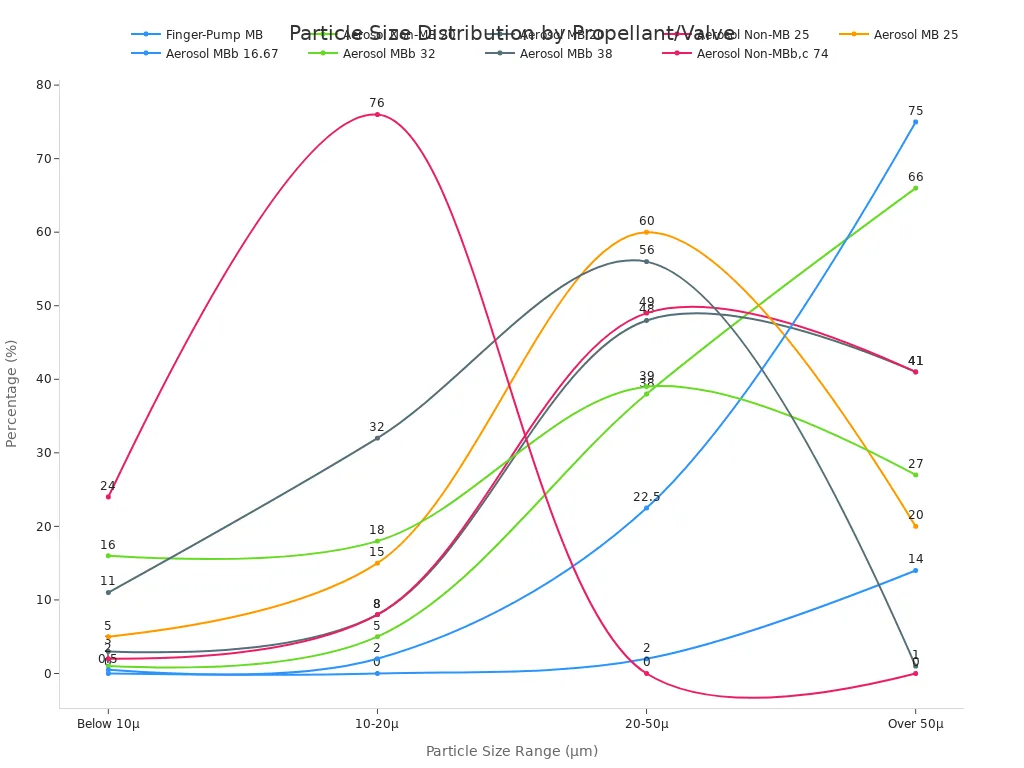
Propellant choice directly affects spray particle size distribution. Unlike most aerosols, where exploding actions caused by the instantaneous depressurization of liquefied propellant act to reduce particle size to various degrees, the particle size of finger-pump sprays is regarded as very coarse. Finger-pump sprays suit surface applications best. As a rule, spray particles from finger-pump units strike the floor within five seconds or less, regardless of the initial direction of the spray. The only aerosols whose sprays compare with those of finger-pumps are nitrosols, which use 1 to 6 grams of nitrogen gas depending on size, and water-based types designed to have the hydrocarbon propellant separate on top as a discrete layer.
You control particle size through three techniques: adjusting nozzle designs, modifying formulations, and optimizing propellant mixtures. These techniques help you achieve desired spray characteristics and ensure consistent product quality. The table below shows how different valve and propellant combinations affect particle size distribution:
Type & Valve
Propellants
% Below 10μ
% 10-20μ
% 20-50μ
% Over 50μ
Finger-Pump
mechanical breakup (MB)
0
0
2
14
Aerosol Non-MB
20
1
5
38
66
Aerosol MB
20
3
8
48
41
Aerosol Non-MB
25
2
8
49
41
Aerosol MB
25
5
15
60
20
Aerosol MB
16.67
0.5
2
22.5
75
Aerosol MB
32
16
18
39
27
Aerosol MB
38
11
32
56
1
Aerosol Non-MB
74
24
76
0
0
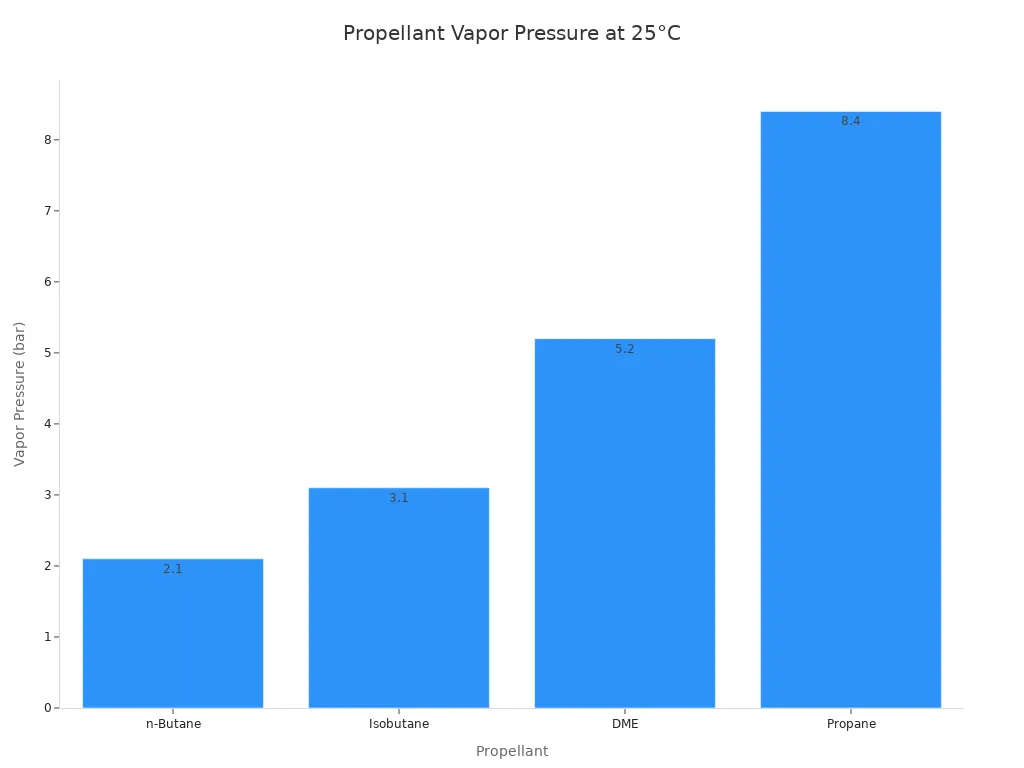
Propellant vapor pressure at 25°C influences your can design and safety requirements. You must select a container rated for your propellant's pressure. The table below summarizes key propellant properties:
Propellant
Vapor Pressure at 25°C
Flammability
Recommended Container Material (Max Working Pressure)
Design / Safety Implication
Propane
~8.4 bar
Highly Flammable
Aluminum (12–18 bar) or Tinplate Steel (12–15 bar)
Lower pressure allows thinner walls; still requires flammable-grade safety measures.
Isobutane
~3.1 bar
Highly Flammable
Aluminum (12–18 bar) or Tinplate (12–15 bar)
Moderate pressure; container rating easily satisfied; flammability governs storage and handling.
Dimethyl Ether (DME)
~5.2 bar
Flammable
Aluminum (12–18 bar)
Pressure within safe range for standard cans; flammability still mandates spark-proof filling lines.
Carbon Dioxide
Gas phase only
Non-Flammable
PET with Barrier Coating (8–10 bar) or Steel
No flammable hazard; lower container pressure rating acceptable; pressure decreases during use (affects valve design).
Nitrogen
Gas phase only
Non-Flammable
PET with Barrier Coating (8–10 bar) or Steel
Non-flammable simplifies safety; but high initial pressure (6–12 bar) may require pressure-relief devices.
As butane is emitted and undergoes photochemical reactions in the atmosphere, it contributes to the growth of existing particles and the formation of new ones. This process alters the overall size distribution of aerosols, typically shifting it towards larger particles. The increased presence of larger particles can have several environmental consequences. You should consider these environmental factors when selecting your propellant.
How SiHai Ensures Component Compatibility and Performance
SiHai provides custom empty aerosol cans and components that work together as an integrated system. The company performs rigorous quality control tests to verify valve and actuator compatibility. These tests follow a defined sequence:
Immersion testing exposes stem and seal materials to the formulation at defined times and temperatures, recording changes in swelling, hardness, cracking, or loss of chemical resistance.
Functional spray tests then show whether the aerosol spray valve stem still operates correctly after immersion.
Extraction analysis looks for substances transferred from valve materials, with a migration study when food-contact exposure requires it.
Results become part of quality assurance records supporting regulatory compliance.
Leak detection protocol uses 100% leakage testing on lines and lab testing every ~2 hours to identify seal failures.
Pressure and dimensional compliance testing catches variation before shipment.
Actuator compatibility checks ensure the aerosol spray valve stem works with the button or spray head as intended.
SiHai also conducts these additional compatibility tests:
Compatibility Testing: Before full-scale production, test the valve materials against the product formulation to detect chemical reactions, swelling, or shrinkage of valve components.
Spray Pattern and Flow Consistency: Perform controlled tests to evaluate spray pattern, flow rate, and overall consistency, adjusting orifice sizes or actuator types based on results.
Environmental Stress Testing: Test valves under varying temperatures, humidity, and storage conditions to confirm performance and identify potential failures.
Weight Loss Testing: Measure product weight over extended periods to monitor retention and detect gradual leakage or evaporation.
Corrosion Resistance: Use stainless steel and aluminum valves for better corrosion resistance in high-moisture environments.
Valve Seal Integrity: Test rubber or elastomer seals to ensure they remain intact under varying pressures and temperatures.
Real-World Simulations: Set up simulations with actual product storage and usage conditions to observe valve performance over time.
These tests confirm that your custom empty aerosol cans perform as intended throughout your product's shelf life. SiHai combines component expertise with manufacturing precision. The company helps you select the right valve, actuator, and propellant combination for your specific application. This integrated approach reduces development time and prevents costly compatibility failures.
Pressure, Safety, and Regulatory Compliance
Understanding Pressure Ratings and Burst Pressure Requirements
You must verify your can's pressure rating before filling. DOT 49 CFR sets a clear minimum:
In any event, the metal container must be capable of withstanding without bursting a pressure of at least one and one-half times the equilibrium pressure of the contents at 54.4 °C (130 °F).
Wall thickness directly governs burst resistance. Three factors determine burst strength: wall thickness, alloy grade, and dome design. Larger-diameter cans need proportionally thicker walls or stronger steel.
Can Diameter
Wall Thickness Requirement to Contain Same Pressure
52 mm
Baseline (reference)
57 mm
Proportionally thicker walls or higher-strength steel grade
60 mm
Proportionally thicker walls or higher-strength steel grade
Meeting DOT, UN, and EPA Regulations for Aerosol Cans
Under the UN Model Regulations, aerosols fall under Class 2 (Gases) with identification number UN 1950. The table below shows the three divisions:
UN Division
Hazard Class Name
Criteria & Thresholds
Required Transport Markings
Division 2.1
Flammable Gas
> 85% flammable ingredients OR heat of combustion ≥ 30 kJ/g
Class 2.1 Flammable Gas diamond placard, UN 1950
Division 2.2
Non-Flammable, Non-Toxic
< 1% flammable components and heat of combustion < 20 kJ/g
Class 2.2 Non-Flammable Gas diamond placard, UN 1950
Division 2.3
Toxic Gas
LC50 values ≤ 5,000 ppm
Class 2.3 Poison Gas diamond placard, toxic inhalation hazard notations
You also follow EPA rules for volatile organic compounds and propellant emissions.
SiHai's Commitment to Safety and Quality Standards
SiHai holds ISO 9001 and ISO 14001 certifications for quality management and environmental standards. SiHai performs burst pressure testing on every batch of custom empty aerosol cans. The procedure follows strict steps:
Calibrate a Hydrostatic Tester with a standard pressure gauge to keep error within ±0.02MPa. Verify the water bath temperature is stable at 23±2°C.
Extract 12 random samples per batch. Clamp each sample with a high-precision fixture.
Inject pressurized water at 0.1MPa/s. Record the deformation pressure when the bottom lid everts. Continue until rupture, then record the final burst value and location.
This rigorous approach ensures your custom empty aerosol cans meet all safety requirements.
Cost, Sustainability, and Practical Selection Steps
Balancing Cost and Environmental Considerations
You face a critical trade-off between cost and environmental impact. According to the Global Aerosol Recycling Association, less than 10% of aerosol cans are recycled globally each year. This low rate means most cans end up in landfills or incinerators. You can reduce your product's carbon footprint through smart propellant selection. The table below shows the global warming potential of common propellants:
Propellant Type
GWP Index (approximate)
LPG Blend A
3–4
Nitrogen
0
DME Mix
1
Nitrogen offers the lowest climate impact. A typical aerosol contains 10–15% propellant by weight. This component significantly drives your overall environmental footprint. You should also consider cost-saving design choices. Simplifying can body geometry reduces aluminum usage and lowers raw material costs. Standardizing top and bottom designs cuts production expenses.
Following a Step-by-Step Selection Checklist
You can avoid common pitfalls by following a systematic approach. First, determine your required spray pattern to select the right valve type. Second, assess dosage control needs. Metered valves are essential for precision applications like pharmaceuticals. Third, verify compatibility between the valve, propellant, and product viscosity. You must also avoid these frequent mistakes:
Wrong propellant selection causes poor spray force and compliance violations
Material incompatibility leads to corrosion and costly recalls
Overfilling creates overpressure and DOT violations
Faulty valve functionality results in sputtering sprays and propellant loss
Leveraging SiHai's Expertise for Cost-Effective, Sustainable Solutions
SiHai helps you balance performance, cost, and environmental responsibility. The company provides custom empty aerosol cans optimized for material efficiency. SiHai also guides your propellant selection toward lower-GWP options. Their expertise ensures you avoid costly design errors and regulatory penalties. With SiHai, you achieve reliable performance without compromising sustainability goals.
You choose the right aerosol can by aligning your product's properties with the can material, valve, propellant, and pressure rating. Start with a compatibility test between your formula and the can lining or valve elastomers. Consult DOT 49 CFR and UN Model Regulations for safety. Consider lifecycle costs, including recycling fees and propellant efficiency. Partner with trusted suppliers like SiHai for optimal performance, safety, and compliance.
FAQ
How do you test formula compatibility with an aerosol can?
You run accelerated storage tests, electrochemical corrosion tests, and salt spray exposure. SiHai performs these tests on custom empty aerosol cans before production.
Which propellant works best for water-based formulas?
Compressed gases like nitrogen or carbon dioxide suit water-based formulas. These propellants do not liquefy and reduce corrosion risk inside the can.
What pressure rating does your aerosol can need?
Your can must withstand 1.5 times the equilibrium pressure at 54.4°C. Always verify burst pressure ratings before filling and transport.

 en
en ru
ru es
es pt
pt zh-CN
zh-CN