1. Convenient and fast: Using aerosol can spray can realize rapid spraying of liquid, which is easy to operate and use.
2. Fine spray: Aerosol can spray can spray fine and uniform liquid mist, which can meet the needs of different occasions.
3. Mass production: Aerosol can sprayers are simple to produce and suitable for large-scale production applications. Common aerosol can spray products include pharmaceuticals, cosmetics, cleaners, paints, etc.
4. Environmental protection and energy saving: The aerosol can spray can be sprayed evenly to reduce liquid waste, which is in line with the concepts of environmental protection and energy saving.
To sum up, aerosol can spray technology is a convenient, fast and precise spray technology, which has the advantages of mass production, environmental protection and energy saving. Aerosol can sprayers are widely used, covering pharmaceuticals, cosmetics, detergents, paints and other fields.
The application history of the three-piece can has been nearly 200 years, although it has been improved many times, its basic composition is still made of three metal sheets (mostly tinplate) from the body of the can, the bottom of the can and the lid of the can, so it is named "three-piece can". Its shape, size and manufacturing method of the bottom and lid of the ordinary three-piece can are exactly the same, collectively referred to as the lid. There are two main sealing forms of the longitudinal seam of the tank body: tin welding and fusion welding. The former was used earlier, but it has been eliminated because of the lead in the solder. The latter can avoid lead pollution, low energy consumption, less material consumption, but the production equipment is complex.
The three-piece can has the characteristics of good rigidity, can produce cans of various shapes, high material utilization rate, easy to change size, mature production process, and many kinds of packaging products.
For the whole aerosol products, aerosol cans are an important part, it not only bears the role of the appearance of the packaging, but also adhere to the responsibility of the product leakage. At the same time, aerosol cans as the main body of high pressure resistance, but also aerosol product leakage, corrosion of the high incidence of the site. So how to select the aerosol cans, the production of aerosol products, is the first and second most important.Usually we are classified according to the material of the can. Currently, there are two common types on the market: tinplate aerosol cans and aluminium aerosol cans.Among them, tinplate cans are the aerosol products in larger quantities, but also more affordable aerosol cans.
From the shape can be divided into straight-wall cans, necked-in cans and so on.
Necked-In Cans Straight-Wall Cans
From the internal coating, can be divided into plain cans and internal coating cans.
Plain Inside Golden Lacquered Inside
From the manufacturing structure can be divided into three-piece cans, two-piece cans and so on.
Three-piece Cans
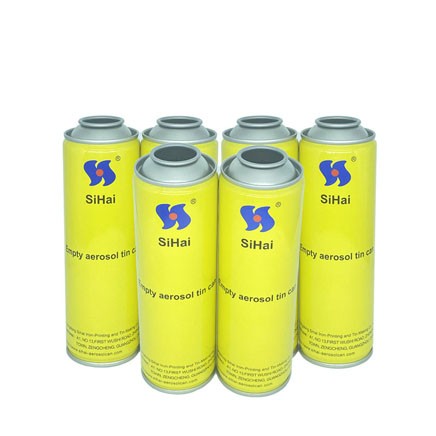
Guangdong Sihai specialises in manufacturing three-piece empty aerosol tin cans, with 25 years of experience, and has been committed to producing the safest aerosol cans. If you have any requirements, please feel free to contact us.
1. Stability / Compatibility
Any aerosol can products, the first thing is to ensure that the product is stable, reliable, select the product cans according to the type of product, the characteristics of the formula to do compatibility, stability testing.
2. Safety
Safety is the first choice for any project, including the use of safety, pressure safety, environmental safety, toxicity safety, the contents of the aerosol cans in the proportion of full water weight and so on.
3. Comfort to use
Any product production and sales, will be used by the final consumer, the use of comfort, ergonomics, spray effect, fragrance concentration, etc., related to the longevity of the existence of the product.
4. Economy
Excessive use of packaging materials is actually a waste of resources, so the choice of suitable packaging materials is an appropriate protection of resources.
Key points for choosing aerosol cans
1. Stability/compatibility
For any aerosol can product, the first thing is to ensure the stability and reliability of the product. The cans of the selected products are tested for compatibility and stability based on the type of product and the characteristics of the formula. Only with data support can we have a theoretical basis for products to flow into the market. Of course, the stability test does not mean that there is no problem 100%. It is only a representative test. There may be unknown problems in the follow-up, but it can represent the vast majority.
2. Security
Safety is the first priority for any project. The safety here includes usage safety, pressure safety, environmental safety, toxicological safety, the proportion of the contents in the aerosol can’s full water weight, etc. What R&D engineers develop is not only products that can bring profits to the boss, but more importantly, safe products that can bring benefits to society.
3. Economical
Excessive use of packaging materials is actually a waste of resources, so choosing suitable packaging materials is a suitable way to protect resources.
The working principle of aerosol canister spray mainly depends on the internal pressure,and the interaction of the liquid and the nozzle. The inside of the aerosol tank is usually filled with liquid and compressed gas, and the pressure of the compressed gas forces the liquid to spray out through the outlet nozzle. When the nozzle button is pressed, the nozzle opens, causing the compressed gas and liquid to mix and spray out. Inside the aerosol tank, the compressed gas usually exists in liquid form, and when the nozzle button is pressed, the liquid gas is quickly evaporated into a gaseous state, while forcing the liquid to spray out through the outlet nozzle. The fluidity of liquid is the key factor for its application in aerosol canister spray, and the choice of liquid has an important effect on the spray effect.
In addition, the structure of the nozzle also plays a decisive role in the spray effect. For example, a nozzle with a porous core or a non-porous core can subdivide the ejected liquid into tiny fog particles, making the liquid more delicate and uniform after the ejected
There are four major components of an aerosol products, the aerosol can, the valve, the feed, and the ejector gas. Factors affecting the quality of aerosol cans, from raw materials, can-making equipment and processes to quality testing, there are many, the following is a brief introduction:1、The quality of tinplate materials:Tinplate substrate for the manufacture of cans requires high purity, such as impurity content is too high, affecting the ductility, brittleness, hardness and other processing properties and corrosion resistance.The tinplate materials we use are of the highest quality, one of the best tinplate, the quality is guaranteed! 2、The quality of cans body welding and repainting:For tinplate cans, one of the weaker links is the weld, which requires strict mechanical properties. The welding machine used in our Sihai factory is the world famous Switzerland SOUDRONIC machine, the quality is guaranteed.
3、Leak detection:
Aerosol products are mostly flammable and explosive products, each factory empty aerosol cans must be tested by online pressure leakage detection machine, and at the same time must be in accordance with the provisions of the deformation pressure and bursting pressure sampling, in order to ensure the safety of the product production, storage, transportation and use. Our Sihai factory not only has automated gas detection, but also manual hand inspection link, product safety can be assured.
If you have any needs for the empty aerosol tin cans, please feel free to inquire, we will provide you with the best quality service.
In today's world, empty aerosol tin cans are not just disposable tools, but versatile materials that can be used in various creative ways. Whether in art, crafts, or daily life, empty aerosol tin cans demonstrate their unique value and utility.
Applications in Artistic Creation
Empty aerosol tin cans play a significant role in artistic creation. Many artists use them for graffiti, murals, and sculpture. Their unique spraying effects and a wide range of color options provide artists with infinite creative possibilities. By skillfully manipulating the pressure and angle of the spray paint, artists can create lifelike images and stunning effects.
Utilization in Handicrafts
Empty aerosol tin cans are also widely used in the field of handicrafts. People use them to add color and enhance aesthetics to handicrafts. For example, using empty aerosol tin cans to color handmade flowers, decorations, and crafts can give them a vivid and appealing appearance.
Practical Uses in Daily Life
Apart from art and handicrafts, empty aerosol tin cans also have various practical uses in daily life. For instance, they can be used to repair and paint furniture, walls, and decorations, giving them a fresh look. Additionally, empty aerosol tin cans can be used for temporary marking, warning signs, and DIY decorations, adding fun and creativity to life.
Conclusion
In conclusion, empty aerosol tin cans are not just simple spraying tools but creative and versatile materials. In art, crafts, and daily life, they exhibit their unique charm and practicality. With the growing demand for creativity and personalization, it is believed that the application of empty aerosol tin cans will become increasingly widespread, bringing more surprises and joys to our lives.
1. Lightweight and easy to carry: The aluminum aerosol can is a lightweight aerosol can that is easy to carry and convenient for users to use anytime and anywhere.
2. Anti-corrosion and good sealing, At the same time, they use advanced sealing technology to effectively prevent external oxygen and other components from entering the can, ensuring the safety of the contents inside the can. Stable and extend the service life of goods.3. Beautiful and elegant: The tin aerosol can has a beautiful and elegant appearance, conforms to modern aesthetic concepts, and has a good decorative effect.4. Good stability: Because tin aerosol cans are made of iron, they have good stability and durability and are not easy to deform, age or be damaged.5. Environmental protection: Tin aerosol cans can be recycled and reused, complying with environmental protection requirements and reducing environmental pollution.6. Wide range of applications: Tin aerosol cans are suitable for many fields, such as cosmetics, food, medicine, etc., and have a wide range of applications.7. Easy to use: Tin aerosol cans are easy to use and simple to operate, and users can easily master how to use them.
Empty Aerosol Tin Cans: Sustainable Solutions for a Greener Tomorrow Empty Aerosol Tin Cans: Sustainable Solutions for a Greener Tomorrow
Empty aerosol tin cans might seem like mere waste at first glance, but in the realm of sustainability, they hold untapped potential for a greener future. These seemingly discarded containers can be repurposed, recycled, and contribute to a more environmentally conscious society.
Repurposing Empty Aerosol Tin Cans:
Instead of relegating them to the landfill, consider giving empty aerosol tin cans a second life. With a bit of creativity, they can be transformed into various DIY projects. From storage containers to artistic sculptures, the possibilities are vast. Get inspired and turn what was once considered waste into something functional and aesthetically pleasing.
Recycling for Resource Conservation:
Empty aerosol tin cans are highly recyclable. Recycling these cans not only conserves valuable resources but also reduces the energy required for the production of new materials. Many local recycling facilities accept aerosol cans, so make sure to check with your community recycling program. By participating in recycling initiatives, you contribute to the circular economy and minimize the environmental impact of these containers.
Reducing Carbon Footprint:
Choosing products packaged in aerosol tin cans with a focus on sustainability is another way to make a positive impact. Many companies are now adopting eco-friendly packaging practices, using recycled materials for their cans, and investing in carbon-neutral initiatives. By supporting such brands, you play a role in promoting a more sustainable approach to aerosol can manufacturing.
Innovations in Aerosol Can Technology:
The empty aerosol tin can industry is not stagnant; innovations continue to emerge. Researchers and manufacturers are exploring alternative materials and eco-friendly propellants to further minimize the environmental footprint of aerosol cans. Stay informed about these advancements to make conscious choices that align with your commitment to sustainability.
In conclusion, empty aerosol tin cans are not just waste; they represent an opportunity for positive environmental action. Through repurposing, recycling, and supporting sustainable practices, we can collectively contribute to a future where every can plays a part in building a more sustainable and eco-friendly world.
Guangdong Sihai Iron-Printing and Tin-Making Co.,Ltd, a manufacturer in producing empty aerosol cans for 25 years, becomes an advancer in our technologically mature field.Our product line includes empty aerosol tin cans in various sizes (Diameter 45/52/57/60/65/70mm) as well as aerosol tops (cones) and bottoms (domes)and accessories such as valves, nozzles, and plastic caps.One of our biggest advantages is our delivery date assurance. We can supply up to 1000,000 pieces per day with an annual production capacity reaching 300 million. Additionally, we can supply up to 50 million sets of domes and cones per month.As a direct supplier and manufacturer of aerosol cans, we can offer affordable prices to our customers by cutting out the middleman. Our factory is solely focused on producing high-quality aerosol tin cans and accessories.
We believe that our empty aerosol cans will truly meet your requirements. Don’t hesitate to contact us for details!Hope we can have long term business with you in near future.
Aerosol tin can is widely and daily use, and it's flammable and combustible products, we need to know how to store the aerosol tin cans to keep safe.
First, we need to ensure the store environment is dry and shady. Do not place it under sunlight.
Second, the aerosol can should keep upward in flat place.
Thirdly, it needs to avoid impacting or deforming.
Guangdong Sihai Iron-Printing and Tin-Making Co., Ltd is a professional 3-piece empty aerosol tinplate can factory over 25 years, we have strict quality control system to ensure the safety for aerosol tin can products.
We have diameter 45/52/57/60/65/70mm, with various sizes and different pressure to meet customers request, welcome to send your inquiry for us.
.jpg)
.jpg)
.jpg)
.jpg)
.jpg)
.jpg)
.jpg)
.jpg)

 en
en ru
ru es
es pt
pt zh-CN
zh-CN