Tinplate aerosol cans (3-piece tinplate
cans) are classified as pressure packaging containers, so
purchasing them requires strict attention to material quality, pressure
resistance, welding stability, internal lacquer, valve compatibility, and
transport safety.
Below are the essential points every buyer
should check before placing an order.
Structure & Specifications
1. Confirm standard dimensions
Common diameters: 45/52/57/60/65/70 mm
Height: 100–300 mm
Make sure size and structure meet local market requirements (EU/US/SEA).
2. Tinplate thickness
Typical thickness:
0.18 / 0.20 / 0.22 / 0.23 mm
Recommended:
Daily chemical products: 0.20–0.22 mm
Industrial/automotive chemicals: 0.22–0.23 mm
Pressure & Safety Standards
1. Request a full pressure test report
Reports must include:
Test
Standard Requirement
Leak/Pressure Resistance Test
≥ 12 bar (industrial products
15–18 bar)
Burst Test
≥ 18–22 bar
If a supplier cannot provide these tests,
do NOT purchase.
2. Bottom dome quality
Check for:
Uniform deep drawing
No deformation or dents
No sharp edges or burrs
The can bottom supports most of the
internal pressure.
Tinplate Material & Internal Lacquer
Correct internal lacquer
Internal coating must match chemical
properties:
Product Type
Recommended Internal Lacquer
LPG (propane/butane)
Epoxy lacquer
Brake cleaner / Engine cleaner
Gold anti-corrosion lacquer
Insecticide
Food-grade epoxy
Strong solvents
Epoxy-phenolic lacquer
Cans without proper internal lacquer will
corrode over time.
Welding Quality
High-frequency automatic welding is
mandatory
Check:
Smooth welding line
Full coating on welding seam
No gaps or pinholes
Printing & Appearance
1. Color consistency & gloss quality
Check for:
Color uniformity
No oil marks, smudging, or misalignment
2. Surface defects
Reject cans with:
Scratches
Dents
Rim deformation
Any damage may affect pressure stability.
Valve & Actuator Compatibility
Even a high-quality can will fail if the
valve is incompatible.
1.Valve size
Standard valve: 1-inch (25.4 mm)
2. Actuator selection
Must match the viscosity and application:
Product
Recommended Actuator
Spray paint
Fan-shaped nozzle
Foam
Foaming actuator
Lubricating oil
Straw/extension tube actuator
Supplier Capability & Quality
Control
1. Manufacturing automation level
Prefer factories with:
Automatic welding
Automatic leak testing
Vision inspection systems
Automatic seaming & necking
Higher automation = more stable quality.
Top 5 Critical Points You MUST Confirm
To avoid 90% of quality issues:
Pressure test results (Leak & Burst Test)
Tinplate thickness + internal lacquer suitability
Weld seam quality and coating coverage
Valve and actuator compatibility
Printing durability (Rub Test)
If these five areas pass, the product is
generally safe and reliable.
Yarlung Tsangpo River hydropower project as a major national infrastructure projects, if the full start, may indeed have a phased impact on the steel industry.
The main material of empty aerosol tin can is tinplate, now the price of tinplate will be increased, we have to adjust the price of our cans.
Please let us know if you have any plan, we can prepare the material in advance.
Guangdong Sihai Iron-Printing & Tin-Making Co., Ltd. was founded in 1998, located in the beautiful tourist city of Zengcheng, Guangzhou. Our company covers an area of 38,000 square meters and our main business is tinplate trading, coil cutting, coating, printing and tin-making.
Key points for choosing aerosol cans
1. Stability/compatibility
For any aerosol can product, the first thing is to ensure the stability and reliability of the product. The cans of the selected products are tested for compatibility and stability based on the type of product and the characteristics of the formula. Only with data support can we have a theoretical basis for products to flow into the market. Of course, the stability test does not mean that there is no problem 100%. It is only a representative test. There may be unknown problems in the follow-up, but it can represent the vast majority.
2. Security
Safety is the first priority for any project. The safety here includes usage safety, pressure safety, environmental safety, toxicological safety, the proportion of the contents in the aerosol can’s full water weight, etc. What R&D engineers develop is not only products that can bring profits to the boss, but more importantly, safe products that can bring benefits to society.
3. Economical
Excessive use of packaging materials is actually a waste of resources, so choosing suitable packaging materials is a suitable way to protect resources.
There are four major components of an aerosol products, the aerosol can, the valve, the feed, and the ejector gas. Factors affecting the quality of aerosol cans, from raw materials, can-making equipment and processes to quality testing, there are many, the following is a brief introduction:
1、The quality of tinplate materials:
Tinplate substrate for the manufacture of cans requires high purity, such as impurity content is too high, affecting the ductility, brittleness, hardness and other processing properties and corrosion resistance.The tinplate materials we use are of the highest quality, one of the best tinplate, the quality is guaranteed!
2、The quality of cans body welding and repainting:
For tinplate cans, one of the weaker links is the weld, which requires strict mechanical properties. The welding machine used in our Sihai factory is the world famous Switzerland SOUDRONIC machine, the quality is guaranteed.
3、Leak detection:
Aerosol products are mostly flammable and explosive products, each factory empty aerosol cans must be tested by online pressure leakage detection machine, and at the same time must be in accordance with the provisions of the deformation pressure and bursting pressure sampling, in order to ensure the safety of the product production, storage, transportation and use. Our Sihai factory not only has automated gas detection, but also manual hand inspection link, product safety can be assured.
If you have any needs for the empty aerosol tin cans, please feel free to inquire, we will provide you with the best quality service.
Guangdong Sihai Iron-Printing and Tin-Making Co.,Ltd is a factory of producing various sizes of Empty Aerosol Tin Cans and Aerosol Components Cones&Domes and Printed Tinplate Sheets for more than 24 years in China.
Our main product is a variety of 3 pieces empty aerosol tin cans. We can manufacture 6 sizes of aerosol cans namely diameters of 45/52/57/60/65/70mm. These aerosol cans can be used in various fields, such as air freshener, personal care products, home care products, spray painting products, festivals, butane gas, etc.
But do you know the process of making these aerosol cans?
Step 1: Iron-cutting——cut the roll tinplate material into tinplate sheets of appropriate size for making the cans.
Step 2: Tinplate sheets-printing——color printing with imported Japan FUJI machine according to customer's design, such as clear lacquered,golden coating,CMYK color printing,Pantone color printing.
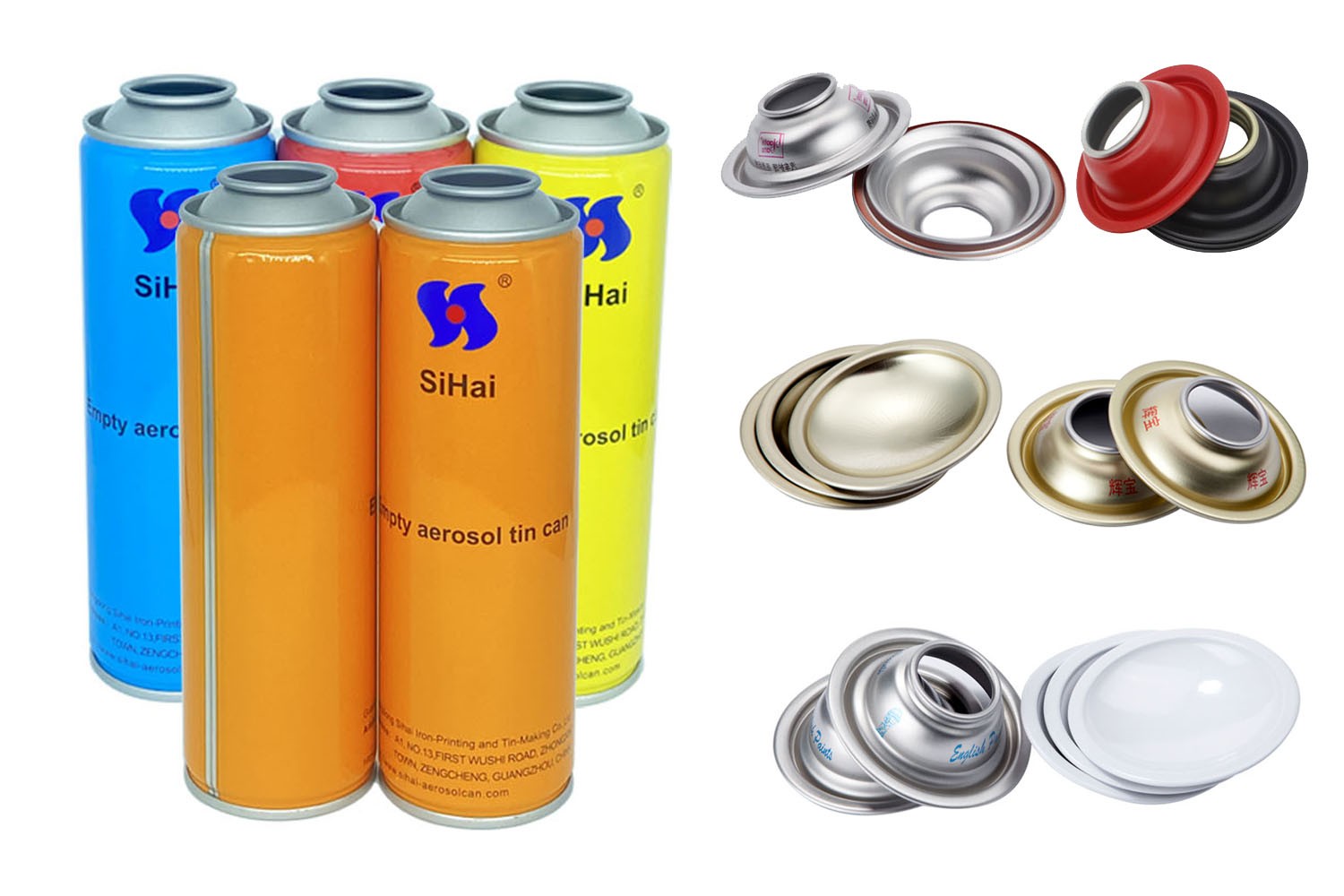
Step 3: Cone & Dome Pressing——cut and press the tinplate sheets with clear lacquered or gold coating into 45/52/57/60/65/70mm cones and domes
Step 4: Aerosol can making——We have 10 production lines to go through the process of welding, gluing, drying, flanging, sealing, crimping, inspection, etc. to assemble tinplate sheets and cones and domes to make a complete empty aerosol tin can. The SOUDRONIC welding machine, air inspection machine and infrared ray auto-inspection machines for provide quality assurance for our products.
Step 5: Aerosol can packing——We usually use the wooden pallets or cartons for packaging. Please inform us in advance if you have special packaging requirements.
If you want to know more, please feel free to contact us!
Guangdong Sihai Iron-Printing & Tin-Making Co., Ltd. was founded in 1998, located in the beautiful tourist city of Zengcheng, Guangzhou. Our company covers an area of 55,000 square meters and our main business is tinplate trading, coil cutting, coating, printing and tin-making. Our company has 2 advanced Japan Fuji PRIMEX-F452 print lines, 2 paint lines and 6 high-speed tin-making lines, and more than 20 automatic punching machines and plastic injection machines, with an annual production capacity of 200 million tins. We are guided by the business purpose of "quality first, customer first" to provide you with high quality products and efficient services. We invite you to visit our company. Therefore, we welcome all interested companies to contact us for future business discussion. We believe we can guarantee your satisfaction by meeting all your requirements.
At home - deodorant, shaving foam, hairspray, body spray, bug spray, air freshener
On the farm - pictured is a paint marking spray used on cattle to show if they are ready to mate or pregnant
In Medicine - Asthma Inhaler
On the industrial side - cleaner sprays, rust removers, spray paint
On the pitch - Foam spray used by referees in World Cup and Premier League matches
At night - aerosols can spray reflective coatings on animals to avoid traffic accident
In the Kitchen - Olive Oil, Butane Gas
At sea - for small boats, this aerosol horn can be heard a mile away
1, good mechanical properties: tin cans relative to other packaging containers, such as plastic, glass, paper containers, such as the strength are large, and good rigidity, not easy to break. Not only can be used for small sales packaging, and is the main container for large transport packaging.
2, excellent barrier: tin cans have excellent barrier than any other materials, gas barrier, moisture resistance, shading, fragrance are good, coupled with reliable sealing, can reliably protect the product.
3, mature technology and high production efficiency: the tin cans have a long history of production, mature technology and a set of production equipment to match, high production efficiency, to meet the needs of a variety of products packaging.
4, beautifully decorated: metal material printing performance; bright and beautiful pattern trademark, the resulting packaging containers are eye-catching, is an excellent sales packaging.
5, recyclable: in line with international environmental requirements, in line with future product trends.
1920-1950
In 1927, Norwegian engineer Erik Rotheim filed a patent for what would become an amazing success story: the aerosol dispenser. The successful development of a mass-produced aerosol occurred in the United States in the late 1940s. It was developed by Goodhue & Sullivan as an insecticide called "bug bomb".
American soldiers used it to fight insect-borne diseases in the Pacific; 50 million were produced during World War II. Soon after the war, aerosol packaging expanded. in 1947, 4.3 million units were produced for civilian use. Production grew steadily and soon crossed the Atlantic to Europe.
1950-1960
Insecticides and hairsprays were the first products to enter the European market in the early 1950s. Air fresheners, deodorants and shaving foams soon followed, and about 70 million aerosols were produced in Europe during this period.
1960-1970
In the early 1960s, there was a golden age for the aerosol industry. A wider variety of aerosol products entered the market; they were initially made of extruded aluminum, but soon were also made of tinplate.
1970-1980
Production shocked again, reaching 2.2 billion units; an increase of 80% in ten years! During this period, interest in aerosols began to grow.
In the late 1970s, after the publication of the "Molina/Roland" report on the ozone layer, a wave of environmental problems captured the world's attention. Aerosols were thought to represent the role played by chlorofluorocarbons (CFCs) in the thinning of the upper ozone layer, although its contribution to this phenomenon was relatively small.
1980-1990
In the 1980s, the aerosol industry voluntarily switched from CFCs to alternative propellants, and FEA was the first organization to formalize a voluntary environmental agreement with the European Commission (Commission Recommendation 89/349/EEC).
Since 1989, aerosols for European consumers (except for a few medical products such as asthma inhalers) have been CFCs-free.
Production increased by 35% during this decade to 3 billion units.
1990-2000
Since the early 1990s, the protection of the environment has become a key issue in Europe.
Research and development has focused on propellants, packaging and ingredients to make aerosols high-performance products.
Two-component aerosols offer a new generation of aerosol technology and are beginning to expand rapidly.
Following the use of alternative propellants to CFCs, the aerosol industry has demonstrated through various studies that empty aerosols can be effectively included in the normal household waste packaging stream without causing harm. As a result, post-consumer aerosols began to be successfully recycled around the world.
Aerosol production in Europe proceeded steadily to 4.4 billion units, an increase of 48% in this decade, making Europe the global leader in production.
2000-2010
In 2002, the FEA adopted a code of practice on the use of HFCs. Hydrofluorocarbons (HFCs), which have no impact on the ozone layer but are still involved in climate change, should only be used in the aerosol industry in applications where there are no other safe, practical, economical or environmentally acceptable alternatives, i.e. only in technical applications with an ignition source or in pharmaceutical applications.
Aerosol packaging comes in new shapes, more attractive and ergonomic. Europe remains the world leader in aerosol production with 5 billion units produced. in 2008, almost 12 billion units were produced worldwide.
2010-2020
Compressed gas propellants are more widely used and the aerosol industry is focused on producing more cost effective aerosol containers. While plastic aerosols are further developed in the market, maximum efforts are made to improve new systems, such as self-compression bags.
The Future
Embrace the circular economy through multi-stakeholder dialogue to ensure more efficient recycling of aerosol dispensers.
The aerosol tin cans have been applied in a wide range of fields, such as air freshener, insecticide products, home care products, car care products, personal care products, snow spray products, spray paint products etc.
Our factory can manufacture D45/52/57/60/65/70mm size of empty aerosol tin cans with Necked-In and Straight-Wall type, and the height of the aerosol cans can be made according to the customer's requirements. This means that there are many types of aerosol cans available.Now I will introduce you to the common aerosol cans sizes in each field.
Use In Air Freshener
Common sizes: Diameter 52x195mm height(300ml/350ml)
Use In Insecticide Products
Common sizes: Diameter 52x190mm height(300ml/350ml) or Diameter 57x216mm height(400ml/450ml)
Use In Snow Spray Products
Common sizes: Diameter 45/52 necked-in cans
Use In Spray Paint Products
Common sizes: Diameter 65x158mm height(400ml/450ml)
Use In Car Care Products
Common sizes: Diameter 65mm necked-in cans
These are some common types of aerosol cans, but they are not the only ones. We can make customized aerosol cans for you according to your requitments. If you are interested in our products, please feel free to contact us.
There are 2 basic Aerosol Tin Can Classifications. Necked-in, Straight Wall. The propellant in these cans are either classified as Liquefied Gas, or Compressed Gas. The cans are made up of either 2 pieces or 3 pieces.
Both Aerosol Straight-wall and Necked-in Cans are used in the personal care, household, paints, automotive, insecticide, and industrial product industries.
You will see the difference in Straight-wall and Necked-in Cans by looking at the very top of the can which is where it is sealed. The Necked-in can will indent before going into the rim, and the Straight-wall will continue directly into the rim without any deviation. Both are durable, however necked-in cans are considered extremely durable.
Aerosol cans are made in various ways, normally from metals that can safely contain pressurized liquids and gases. Most everyday, household aerosols are made from a thin sheet of steel coated with another material to stop it rusting or reacting with the product or the propellant.
Traditionally the coating is tin, often applied by electroplating, which turns the steel into a material called tinplate. The tinplate is wrapped into a cylinder that has a top and a bottom welded on to ensure the can is completely leak proof.
Environmentally friendly cans are increasingly being made with plastic (polymer) linings instead of tin, which is often cheaper and makes them easier to recycle. Other cans are made by pressing a small lump of aluminum through a ring-shaped tool, called a die, so a cylinder forms from a single piece of metal.
Aerosol sprays contain a substance that is compressed into a liquid. When we press on the nozzle, the liquid in the tank is dispersed in the air in a fine mist.
The pressure inside the tank is much higher than outside the tank, so when the actuator is pressed, the chemical can be forcibly ejected, and over a long distance. This is dangerous because the force can injure people and the distance it travels can make it difficult to control.
Please pay close attention to the aerosol valve. The jar valve regulates the amount of chemical released. Press the nozzle at different pressures to release the right amount of liquid. If this valve is damaged, there may be a slow leak problem, which is dangerous.
The storage of aerosols is subject to certain conditions:
1- Aerosols need to be stored in a dry place, and it is forbidden to store in a high temperature place. Because high temperatures can increase the pressure inside the aerosol can, the pressure reaches a certain level that may cause an explosion. Please do not place it near a window, in the sun or in a vehicle to avoid danger from overheating the tank.
Since the gas or liquid inside may be flammable, it should be stored away from any fire point, including heaters, ovens, test lights, or staff smoking areas.
Please store in a well-ventilated place. A ventilated area can quickly spread dangerous fumes if any gas leaks from the can.
2- Avoid freezing
3- Aerosols should not have anything on them during storage.
Aerosol cans should be stored in safe, well-ventilated areas. Having a cabinet dedicated to aerosol storage can make storage simple.



 en
en ru
ru es
es pt
pt zh-CN
zh-CN