Aerosol Tin Cans Products are widely used in people's daily life, involving medicine, cosmetics, food, industrial building materials, daily chemical, fire, automobile care and other fields. The common products are Yunnan Baiyao aerosol, nasal spray aerosol, shaving foam, depilatory cream, moisturizing water aerosol, cake baking oil mist, edible oil mist, kitchen disinfectant, self spray paint, According to the statistics of aerosol industry association in 2017, the output of aerosol in China has reached 2 billion by 2016, with self spray paint accounting for 15.9%, automobile care and industry (including construction) accounting for 29.6% and personal care accounting for 14.9%. It can not be seen that the domestic aerosol products are developing vigorously. In the future, more and more aerosol products will enter into people's lives.
Aerosol concept: Aerosol is a clear liquid, suspension or emulsion made of effective components and suitable propellant in a pressure tight container with special valve system. When used, the content of the agent is sprayed out of mist particles (or foam) by the pressure of the propellant.
Products of Smoke aerosol are as follows: insecticidal aerosol, aerosol gel, aerosol oil, etc
Products of Foam aerosol are as follows: foam cleaning agents for cars, hair mousse, etc
Products of Fine Flow aerosol are as follows: wasp spray, fire extinguisher, etc
Aerosol products belongs to a low-pressure filling. The liquid in the tank passes through the pressure in the tank. When a person's finger touches the button, change the pressure in the tank and spray the liquid out of the tank. The atomization effect of the liquid is different through the nozzle and the nozzle with different aperture size. Conventional aerosol products are generally completed by three steps of filling, sealing and inflation. Special products involve precipitates or color paste, such as self spray paint and snow ribbon. Before or after filling liquid, one or two glass beads need to be placed, which can disperse the color paste in the tank during use, so as not to cause color difference or uneven spraying of the ejected products. In addition, binary aerosol is also available. The production process of the product is opposite to that of the conventional aerosol production. The product is first inflated, sealed and filled with liquid. This kind of product is applicable to the water-based liquid, the original liquid is corrosive or easy to react with air and other gases. The original liquid does not contact with the gas, and the pressure in the tank is filled between the bag and the bottle wall. When the liquid is filled into the bag, the volume between the bag and the bottle wall decreases. The pressure is increased to ensure that the finished product pressure can make the liquid in the bag spray out.
Propellant: the motive force for the effective components to spray out, sometimes they have the solvent effect of the effective components.
Requirements of the propellant:the vapor pressure at room temperature shall be greater than atmospheric pressure; it shall be non-toxic, non sensitizing and irritant; inert, non reactive with drugs, etc.; colorless, odorless, tasteless; cheap and easy to obtain.
As we all known, aerosol is a colloid of fine solid particles or liquid droplets, in the air or another gas. Aerosols can be natural or artificial.
Frederick G. Donnan presumably first used the term aerosol during World War I to describe an aero-solution, clouds of microscopic particles in the air.
The concept of an aerosol originated as early as 1790 when self-pressurized carbonated beverages were introduced in France. In 1837, a man called Perpigna invented a soda siphon incorporating a valve. Metal spray cans were being tested as early as 1862. They were constructed from heavy steel and were too bulky to be commercially successful.
In 1899, inventors Helbling and Pertsch patented aerosols pressurized using methyl and ethyl chloride as propellants.
On November 23, 1927, Norwegian engineer Erik Rotheim (also spelled Eric Rotheim) patented the first aerosol can and valve that could hold and dispense products and propellant systems. This was the forerunner of the modern aerosol can and valve. In 1998, the Norwegian post office issued a stamp celebrating the Norwegian invention of the spray can.
During World War II, the U.S. government funded research into a portable way for servicemen to spray malaria-carrying bugs. Department of Agriculture researchers, Lyle Goodhue and William Sullivan, developed a small aerosol can be pressurized by a liquefied gas (a fluorocarbon) in 1943. It was their design that made products like hair spray possible, along with the work of another inventor Robert Abplanalp.
In 1949, 27-year-old Robert H. Abplanalp’s invention of a crimp on valve enabled liquids to be sprayed from a can under the pressure of an inert gas. Spray cans, mainly containing insecticides, were available to the public in 1947 as a result of their use by U.S. soldiers for preventing insect-borne diseases. Abplanalp’s invention made of lightweight aluminum made the cans a cheap and practical way to dispense liquids foams, powders, and creams. In 1953, Robert Abplanalp patented his crimp-on valve "for dispensing gases under pressure." His Precision Valve Corporation was soon earning over $100 million manufacturing one billion aerosol cans annually in the United States and one-half billion in 10 other countries.
In the mid-1970s, concern over the use of fluorocarbons adversely affecting the ozone layer drove Abplanalp back into the lab for a solution. Substituting water-soluble hydrocarbons for the damaging fluorocarbons created an environmentally friendly aerosol can that did not harm the environment. This put the manufacture of the aerosol spray can products into high gear.
Robert Abplanalp invented both the first clog-free valve for spray cans and the "Aquasol" or pump spray, which used water-soluble hydrocarbons as the propellant source.
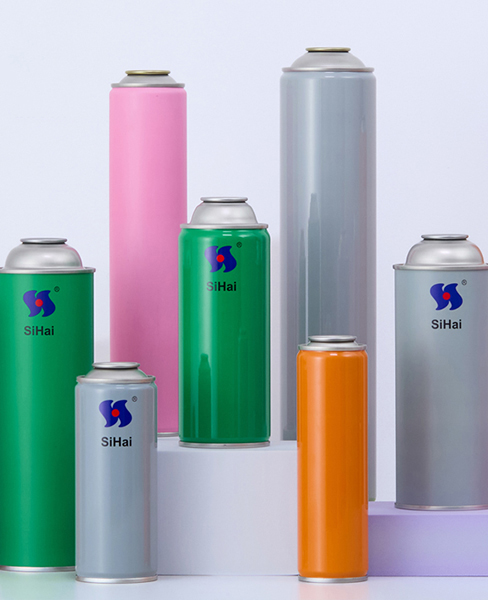
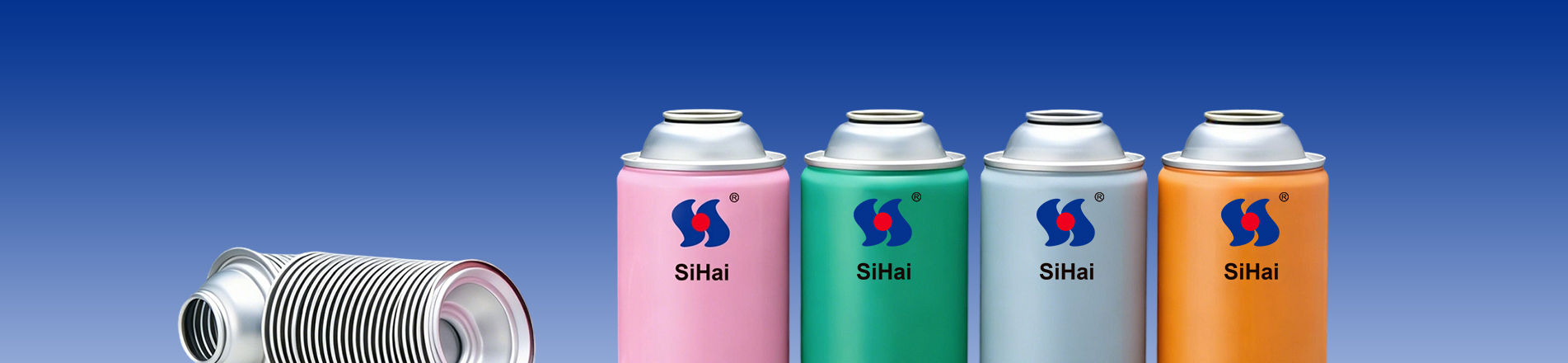
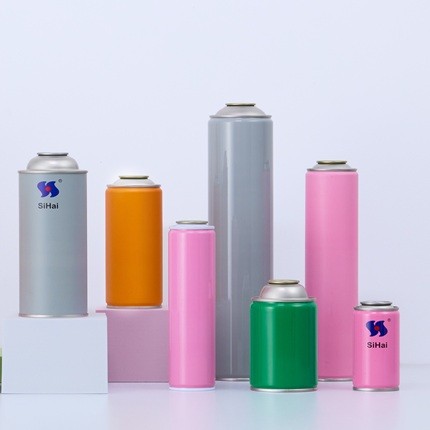
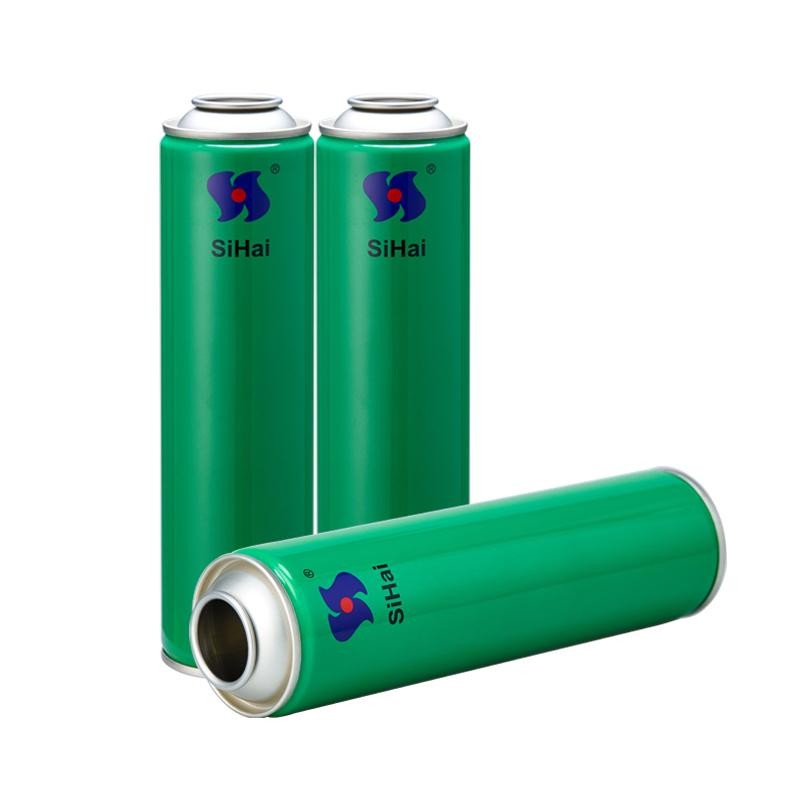
We, Guangdong Sihai Aerosol, specialized in manufacturing aerosol tin cans since from 1988.
Aerosol
cans come in a variety of sizes and shapes and serve as containers for a
variety of substances, but they all work in the same way: by exposing a high
pressure fluid, another fluid is squeezed out of the nozzle.
If you
apply enough energy to the fluid (by heating), the particles in the liquid will
vibrate violently to break the forces that bind them together. In this way, the
liquid becomes a gas and becomes a fluid that makes up the particles to move
independently. This is the boiling process, and the temperature at the time of
boiling is called the boiling point of this substance. Different substances
have different boiling points: for example, the amount of heat required to
change water from a liquid to a gaseous state is more than the amount of heat
required to change the alcohol from a liquid to a gaseous state.
The
forces generated by the individual moving particles in the gas are superimposed
and can create considerable pressure. Because the particles in the gas are not
bound together, the gas does not have a fixed volume like a liquid: the
particles are constantly pushed outward. In this way, the gas will expand and
fill all open spaces.
When
the gas expands, its pressure becomes small, and the number of particles
colliding with each other in any given region is reduced, so the pressure is
simultaneously reduced. When the gas is compressed into a relatively small
space, a large amount of pressure can be generated because there are more
moving particles in a certain area. Aerosol cans use these principles for a
simple purpose: to push a liquid substance out.
The
aerosol canister contains a fluid having a boiling point below room temperature
(referred to as a propellant) and a fluid that is boiling at very high
temperatures (referred to as a product dose). The product dose is the substance
we actually use - such as hair spray or insect repellent. The use of a propellant
is a method of pushing a product agent out of a can. Both fluids are stored in
sealed metal cans.
The liquid product is first filled, after which the aerosol canister is sealed and the gaseous propellant is pumped through the valve system. The gas is pumped under high pressure. Therefore, it squeezes the liquid product agent with a large force. In this aerosol canister, a long plastic conduit extends from the bottom of the can to the valve system at the top of the can. It has a small nozzle that can be pressed, with a narrow pipe in the middle. This pipe extends from the inlet near the bottom of the nozzle to a small nozzle at the top. The spring pushes the nozzle up, so the pipe inlet is firmly blocked by the sealing device.
When
you press the nozzle, the inlet moves under the seal, which opens the passage
from the tank to the outside of the tank. The high pressure push gas drives the
liquid product charge up the plastic conduit and ejects the nozzle. A narrow
nozzle atomizes the flowing liquid - breaking the liquid into tiny droplets to
form a fine spray. The plastic nozzle on the aerosol can pushes a small valve
to allow the compressed product to flow out of the can.
The application of tinplate is very wide. From the packaging materials for food and beverages to grease cans, chemical cans and other miscellaneous cans, the advantages and characteristics of tinplate provide physical and chemical protection of the contents.
Aerosol cans in recent years got more and more uses in industrial area, household construction area, like car care products, paint, cleaner, lubricant, tyre wax and so on, household products covers shoe polish, toilet perfume dispenser, air freshener and so on. Construction refers to PU foam series, .etc.
Being a 21-year rich experienced empty tin can manufacturer, Sihai totally understand the importance of aerosol can safety, and always try all sorts of method with advanced testing equipment to guarantee the can quality. Normally, through the production process, several quality issues listed as below need to be paid attention,
From appearance part:
--rusted can
--flats after cylinder forming
--slip seam
--jumped seam
From machine testing part:
--overlap length
--compound drip from double seam
--pin hole
--WR%
--JR%
Sihai company is equipped with a range of equipment to meet the testing needs, and professional technician team lead the whole work shop to strictly perform various operations, we welcome your visiting and your suggestions will be always highly appreciated.
Shaving foam now is a common personal care product used in our daily life.
A rudimentary form of shaving cream was documented in Sumer around 3000 BC.
Until the early 20th century, bars or sticks of hard shaving soap were used. Later, tubes containing compounds of oils and soft soap were sold.
In 1919 Frank Shields, a former MIT professor developed the first shaving cream.
The first can of pressurized shaving cream was Rise shaving cream, introduced in 1949.
In the 1970s, shaving gel was developed. In 1993, The Procter & Gamble Company patented a post-foaming gel composition, which turns the gel into a foam after application to the skin, combining properties of both foams and gels.
Now you can use the shaving foam just press the actuator, which really make a great convenient to our life. We Guangdong Sihai make the shaving foam aerosol tin can in diameter 45/52/65mm.
Diameter 45mm
Outside: CMYK/Pantone color
Inside: Inner lacquer/plain
Height: 85~180mm
Deform pressure:≥1.8Mpa
Burst pressure:≥2.0Mpa
Diameter 52mm
Outside: CMYK/Pantone color
Inside: Inner lacquer/plain
Height: 100~240mm
Deform pressure:≥1.3Mpa
Burst pressure:≥1.5Mpa
Diameter 65mm
Outside: CMYK/Pantone color
Inside: Inner lacquer/plain
Height: 100~300mm
Deform pressure:≥1.3Mpa
Burst pressure:≥1.5Mpa
Guangdong Sihai Iron-Printing and Tin-making Co., Ltd focus on empty aerosol tin can over 21 years, we accept aerosol tin can in OEM printing, customers provide the design artwork to us, then we will make printing on it.
Regard to tinplate printing effect for aerosol tin can, we have two types iron printing for your choice--white coating (normal effect) & white printing (metallic effect).
White Coating Effect
Generally, to make aerosol tin can, first we do printing on the tinplate sheet, then bending, welding, pressing...For white coating (normal effect), we apply the white oil After iron cutting, then printing customer’s design on it.
The effect will not see the grain of tinplate, the color is more bright-coloured.
Advantage
(1) The thickness is 3-4 times than printing ink, it’s more white and smooth, better gloss than metallic effect one.
(2) The ingredient of white oil is high polymer, with stronger corrosion.
White Printing Effect
This printing effect can clear to see the grain of tinplate, which is more shinny. As the adhesion of tinplate is not good enough with printing ink, so It will be apply bottom oil (clear oil) before printing color on the tinplate.
Advantage
(1) Diaphaneity is good, will not cover the metal texture, the color will not be yellow easy.
(2) With better levelling property, thermal curing property, flexibility.
(3) Better adhesion.
To choice white coating or white printing, it depend on your products and design, then after printing, both of this two types will apply clear lacquer by the last procedure.
Metal cans are used to contain a wide variety of products, including beverages, foods, aerosol products, paints, medicines, and many other products. Metal cans and can parts are made from aluminum or steel two materials. The two basic types of metal cans produced today are 2-piece cans and 3-piece cans.
Now 3- piece aerosol cans are being widely used in cosmetic products series, such as hair spray, perfume, body deodorant and so on.To make sure our products can be used for these materials, we will use interior coatings and exterior coatings.
Interior coatings are applied to protect the can from corrosion by the contents and/or to protect the contents from being contaminated by dissolved metal from the can. Occasionally, however, pigmented interior coatings are applied to enhance the visual appearance of the inside of the can. After the can is fabricated, some facilities spray the interior with additional coating to cover any defects in the roller-applied coating. End seal compounds and interior side seam striping are also interior coatings. Exterior coatings are applied for decoration, to protect the can from corrosion, to protect the printed designs from marring or abrasion, or to reduce friction on the bottom of the can to facilitate handling. Typical exterior coating operations are base coating, size coating, decorative ink and over varnish application, bottom coating, side seam stripe application, and repair coating.
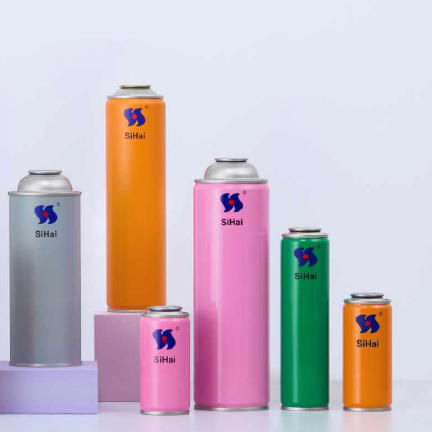
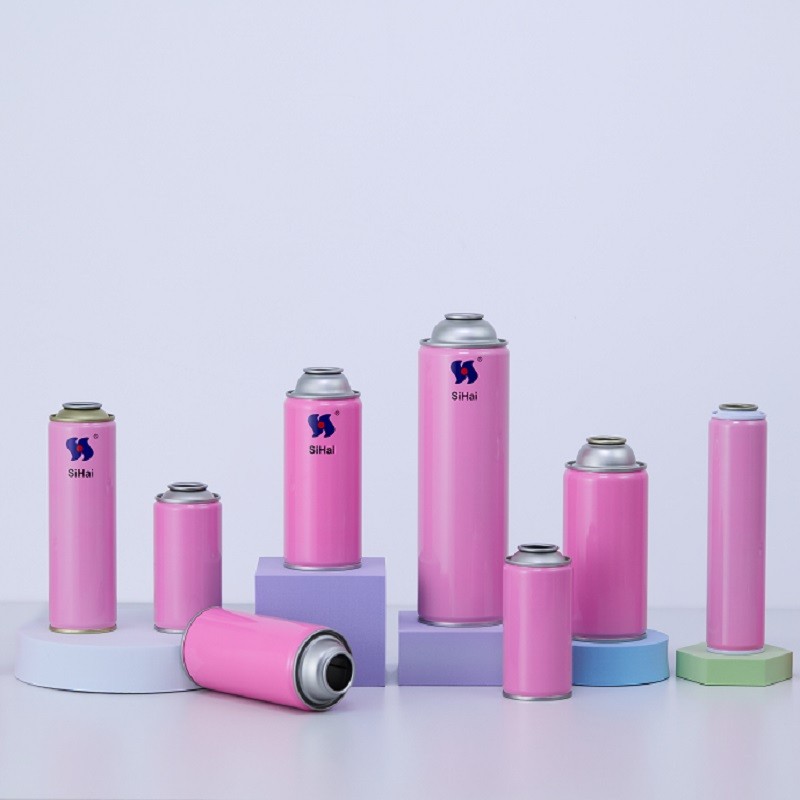
Guangdong Sihai Iron-Printing and Tin-Making Co.,Ltd can offer you ISO approved empty metal cans for you, diameter sizes cover 45mm, 52mm, 57mm, 60mm, 65mm and 70mm.
Our annual output can reach 300 million pcs of cans and welcome your inquires.
Selecting the ideal aerosol can is pivotal for product performance and cost efficiency. Two-piece cans, crafted from a single seamless sheet, boast superior pressure resistance, sleek aesthetics, and efficient material use. However, they demand specialized manufacturing equipment, offer limited size customization, and carry higher production thresholds.
Conversely, three-piece aerosol cans, assembled from a body, top, and bottom, present unmatched versatility. They accommodate diverse sizes, shapes, and coatings, making them ideal for industrial, automotive, and home care products. Their mature production technology ensures stable quality, lower tooling costs, and greater adaptability to small-batch orders. Constructed from robust tinplate, they deliver excellent structural integrity and corrosion resistance.
For a balance of flexibility, reliability, and cost-effectiveness, three-piece cans from Guangdong Sihai Iron-Printing and Tin-Making Co., Ltd. are the premier choice. We offer standardized and customized solutions adhering to international safety and quality standards. We sincerely welcome global clients to consult and place orders.
Seal Process of Three-Piece Aerosol Cans
To ensure the sealing of three-piece aerosol cans, we strictly control the key parts and critical processes, with 100% leak detection to avoid leakage. The key points are as follows:
Core Sealing Control Measures
1. Longitudinal Weld: Stable welding parameters to ensure continuous weld; post-weld internal touch-up coating and full curing, no exposed iron or pinholes.
2. Double Seam: Accurate seaming tool size, qualified seam structure, even sealant application, no false or loose seaming.
3. Raw Materials: High-quality tinplate, can bottom/top, sealant and internal coating, free of defects like rust or cracks.
4. 100% Leak Detection: Adopt water bath leak detection, air pressure decay test or high-pressure leak test to eliminate micro-leakage.
5. In-Process Control: Stable necking/flanging size, complete coating curing, regular seam inspection and performance verification.
Key Leakage-Prone Points
Insufficient weld touch-up coating, insufficient seaming pressure, inadequate sealant, internal coating pinholes and flanging cracks.
Summary
Sealing performance = high-quality weld + complete internal coating + qualified double seam + 100% leak detection, all indispensable for zero leakage.
Aerosol cans are used to store everything from personal care products to chemical products such as spray paint. While the can itself has the same value as other metal cans, the pressurized air inside and potentially hazardous contents make recycling a bit more complicated.
How to recycle aerosol cans correctly becomes an important thing in our daily life.
Aerosol Can Recycling Preparation
Ensure aerosols are completely empty before recycling. Do your best to use up all the product inside. If the can still has product inside, even if it’s nonhazardous product like whipped cream, your recycling program will not accept it. The easiest way to make sure it’s empty is to shake the can and listen for liquid inside, or spray until nothing comes out.
Removed and recycled plastic cap separately.
Do not pierce, crush or flatten aerosol cans, and do not puncture a hole in the can to remove any remaining product, as the can will explode and hurt you.
Do not attempt to remove the spray nozzle on top of the can.
Find a drop-off location for aerosol cans near you using our Recycling Locator.
Around 60% of aerosols are made from tinplated steel and approx 40% are made from aluminium. Both of these metals are recyclable. Aerosols also contain some small plastic and rubber components including the lid, valve and dip tube which are extracted in the recycling process.
Aerosol cans are widely used in industries such as automotive care, household cleaning, spray paints, and personal care products. Choosing the right aerosol can sizeis important to ensure proper product performance, packaging efficiency, and user convenience.
The most common aerosol can diameters include 45mm, 52mm, 57mm, and 65mm. Each size serves different applications depending on product volume and pressure requirements.
The 45mm aerosol can is a compact size often used for smaller products or travel-size packaging.
Typical applications:
Personal care sprays
Air fresheners
Small chemical sprays
Advantages:
Lightweight and portable
Suitable for small filling volumes
The 52mm aerosol can is one of the most commonly used sizes in the aerosol packaging industry.
Typical applications:
Household cleaning products
Insecticides
Air fresheners
Advantages:
Versatile and widely accepted size
Suitable for medium product volumes
The 57mm aerosol can provides slightly larger capacity and stronger structure compared to 52mm cans.
Typical applications:
Spray paints
Automotive maintenance products
Lubricants
Advantages:
Higher filling capacity
Good pressure resistance
The 65mm aerosol canis commonly used for larger-volume or professional-grade spray products.
Typical applications:
Spray paints
Automotive care products
Industrial cleaners
Advantages:
Larger product capacity
Strong and durable structure
Choosing the Right Aerosol Can Size
When selecting an aerosol can size, businesses should consider several factors, including product volume, pressure requirements, transportation efficiency, and packaging design. Working with an experiencedaerosol can manufacturercan help ensure the correct size selection and reliable product quality.
If you are looking for a professionalaerosol tin can supplier, feel free to contact us to learn more about our aerosol can sizes and customization options.
When it comes to tinplate, the difference between First class and secondary class comes down to surface quality. First class tinplate is designed for direct coating and printing across the entire sheet, with strict limits on defects—no pinholes, no out-of-spec thickness, and no visible dents, wrinkles, or rust that could affect performance. Secondary-class tinplate, on the other hand, allows for minor surface imperfections such as scratches, oil marks, or burrs, which makes it unsuitable for high-quality printing.
At Guangdong Sihai, we specialize in manufacturing empty aerosol cans and have done so for 28 years. To ensure the highest level of safety and reliability, we use only first class tinplate for all our aerosol tin cans. This commitment allows us to deliver cans that meet the most demanding standards for coating, printing, and long-term performance. If you have any needs, please feel free to inquiry.

 en
en ru
ru es
es pt
pt zh-CN
zh-CN