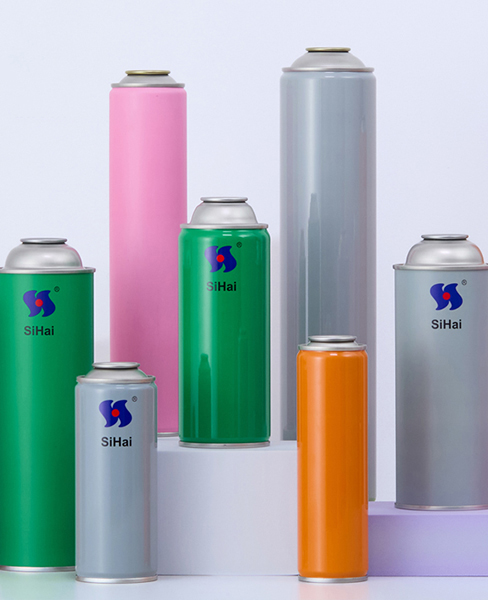
Diameter 57mm empty aerosol tin cans popular in spray paint, insecticide, hair spray, snow spray, car care products..., which with larger volume than diameter 52mm, and more suitable for manual use. We can do the can height from 100 to 240mm, see more details product information as below.
Type: Necked-in
Color of cone & dome: clear lacquer/golden lacquer/white coating/black...
Outside of can body: CMYK/pantone color
Inner of can body: plain/golden lacquer
Thickness of can body: 0.20mm
Deform Pressure:≥1.3Mpa
Burst Pressure:≥1.5Mpa
Packing: pallet/carton
Delivery date: 15-20days
Recommend sizes:
Spray paint: 57*166mm, about 300ml
Insecticide: 57*200mm, about 400ml
Car care : 57*207mm, about 400ml
Hair spray: 57*220mm, about 450ml
Also we manufacturer diameter 45/52/60/65/70mm, height from 85-300mm. The production lines with 4 iron-printing lines and 10 can-making lines, capacity reach 300 million pieces cans, welcome to send your inquiry with detail sizes.
Guangdong Sihai Iron-Printing and Tin-Making Co., LTD. (Guangdong Sihai for short)aim to offer safe empty aerosol tin cans to worldwide customers. Among all incoming materials, tin plates materials are the most important one. Guangdong Sihai use tin plates from Guangzhou Pacific Tinplate Co., Ltd (Patin for short) to guarantee the can with no quality issues.
A good piece of tin plate always got following properties, beautiful appearance, high paintability, excellent formability and high Strength, Excellent Corrosion Resistance and excellent weldability.
Since April,1997, Patin company started its commercial operation, its Site Area is 110,000 Square Meters, and annual production capacity can reach 200,000 Tons . Their main products Electrolytic Tinplate are the very original materials for our aerosol can making.
The raw material for tinplate is called TMBP "Tin Mill Black Plate". PATIN is using the highest quality TMBP from Nippon Steel and its group companies which are produced based on excellent quality management and state-of-the- art technology.
The electroplating equipment PAT IN use is Ferrostan type developed by UEC of USA, which applied in over 60% electroplating productions around the world. PATIN's products have pleasing out-look and strong resistance to corrosion. For tin-coating PATIN leverages the latest insoluble anode technology from NIPPON STEEL ENGNEERING CO..LTD., of which is stable, easy to operate and gives more even coatings.
If tinplates not good enough, when in each process of can making, like forming and curling ones, the tin plates will get defects from a certain level, to avoid this, Patin company use high quality TMBP for aerosol cans with the strictest internal cleanliness. It contribute aerosol can safety minimizing defects after pressing and forming process, excellent mechanical performance realize unique deformability in deep drawing and high speed processing for Mountain Cap and so on.
With those tinplates materials, Sihai aerosol can quality is keeping moving ahead, and we welcome customers with various spray usage to inquire!
Aerosol spray is a type of dispensing system which creates an aerosol mist of liquid particles. It is used with a can or bottle that contains a payload and propellant under pressure. When the container's valve is opened, the payload is forced out of a small hole and emerges as an aerosol or mist. As propellant expands to drive out the payload, only some propellant evaporates inside the can to maintain a constant pressure. Outside the can, the droplets of propellant evaporate rapidly, leaving the payload suspended as very fine particles or droplets.
The safety of the aerosol can depends on the material used, the thickness of the can body and the thickness of the top and bottom cover, and the craftsmanship during production. The top and bottom cone serve as a guarantee for the pressure of aerosol cans. If we need make more tricks on the top and bottom cones, the technology required is higher than normal ones. Now, we, Guangdong Sihai, can do six sizes aerosol top and bottom cones and different colors.
Diameter(mm)
Type
Pressure
Height(mm)
Printing
45mm
Necked-in
Normal Pressure
85-185
4 colors & Inner coating
45mm
Necked-in
High Pressure
85-185
4 colors & Inner coating
52mm
Necked-in
Normal Pressure
100-240
4 colors & Inner coating
52mm
Necked-in
High Pressure
100-240
4 colors & Inner coating
57mm
Necked-in
Normal Pressure
100-240
4 colors
60mm
Necked-in
Normal Pressure
100-210
4 colors
60mm
Straight-Wall
Normal Pressure
150-240
4 colors
65mm
Necked-in
Normal Pressure
100-300
4 colors & Inner coating
65mm
Necked-in
High Pressure
100-300
4 colors & Inner coating
65mm
Straight-Wall
Normal Pressure
100-240
4 colors
70mm
Necked-in
Normal Pressure
100-240
4 colors
We can find the aerosol products around the house for everything from touching up patio furniture, to dusting furniture. You can find them on nearly every jobsite, in most work vehicles, and in offices. They’re small and easy to ignore. But when they explode or depressurize incorrectly, they can be deadly.
Aerosol cans are normally manufactured from thin sheets of steel. The products they hold are highly pressurized with a number of types of hydrocarbon propellants, from carbon dioxide or butane or propane. In recent years, some scientists and environmental activists have linked chlorofluorocarbon (CFC) propellants to decreases in the planet’s ozone layer. Most manufacturers have shifted to propellants that are thought to be less damaging to the atmosphere.
Hazards to workers
Workers face three general types of hazards when working with aerosol cans. The first of these is the pressurization. As long as the can and the dispensing device remain intact, aerosol cans are safe. But any number of problems, such as a puncture, a faulty valve, excessive temperatures, or corrosion can result in unintended depressurization. In the most severe cases, aerosol cans may explode, burning nearby workers and showering them with steel shrapnel.
The second hazard is the actual product being dispensed by the can. Often, these products are inherently hazardous, such as in the case of insecticides. Others may contain hazardous substances, such as the concentrated solvents found in some paints or cleaners. In fact, some cans that are partially empty may be legally considered to be hazardous wastes. Finally, if either the propellant or the product it delivers is flammable, the aerosol can creates a fire hazard.
Safe work practices
As with most hazards, the first steps in reducing the dangers associated with aerosol cans is to determine whether they are really needed on the jobsite. If the task can be accomplished without the use of aerosol cars, workers will not have to contend with the hazards. Other forms of the material may be available. Or, refillable spray bottles or air-powered equipment may be available.
If workers do use aerosol cans, they should be familiar with the Material Safety Data Sheets (MSDS) for the material and use the cans according to directions. Personal protective equipment or additional ventilation may be required.
Aerosol cans should always be stored in dry areas where they will not be exposed to excessive temperatures. As the temperature rises, pressure in the can will increase, and ambient temperatures about 120 degrees Fahrenheit may lead to explosions. Because car and truck interiors can become very hot in sunlight (even during the winter months), vehicles are generally not a safe location for even temporary storage.
Disposal issues
As noted earlier, leftover materials in partially filled cans may qualify as hazardous waste. If a can is found to be inoperative or malfunctioning, returning it to the supplier will prevent the user from having to treat it as hazardous waste.
Cans that are completely empty of both propellant and product are not considered to be hazardous waste, and may be recyclable. Companies that use a significant number of aerosol cans may wish to consider aerosol-puncturing equipment, which allows the contents of cans to be safely removed and prepared for disposal.
Aerosol cans should never be placed in fires or heated locations, because they may explode, and the propellant may be flammable. Cans that are still pressurized may also burst if place in a garbage compactor.
If cans that contain hazardous wastes are to be disposed, they should be placed in a special closed container displaying markings indicating that the waste is hazardous. The labeling should also indicate the specific types of waste and the date when the container began to be used. Keep records of when and how the waste was disposed or recycled.
Packing is a very important part of products, as empty aerosol tin can is semi-finished products, and the thickness of can body is normally 0.18~0.23mm, which will be easy to deform by compression or impact, it may also caused by rude or improper unloading, we need to protect the goods by packing.
There are two manners of packing for empty aerosol tin can--pallet and carton.
Our packing are designed based on container size, which make the maximize container space to use and prevent the goods from shaking during transportation, so that we can load more goods and save freight cost for customers, protect the goods in proper way.
For pallet packing, the advantages of this way is it can load more quantity, and easy to load and unload by forklift. We make 20 pallets for 20GP and 36 pallets for 40GP & 40HQ. We add wooden frame on the top of pallet to make the force uniformly.
About carton packing, it’s easy to load and unload for customers without using forklift. And the disadvantage is scrape by improper size carton. We have special reinforced packing with box partition fot carton, which can protect the cans better.
Only to make proper packing for the goods, not to make unnecessary damage, our customers can use them for next production processes.
Welcome to let us know your packing way you wanted, or contact us to check with the best way.
Aerosol tin can cone and dome, also calledaerosol tin cantop & bottom or aerosol tin can lids, a aerosol tin can is assembled by aerosol cone, tinplate body and aerosol dome.
Guangdong Sihai Iron-Printing and Tin-Making Co., Ltd manufacture aerosol tin can components- aerosol can cone and dome, printed tinplate sheet, we have size diameter 45/52/57/60/65/70mm, and we have high pressure for 45/52/65/70mm.
For outside finish, we have clear lacquer, golden lacquer and white coating or customized color, and we can do inner golden coating for diameter 45/52/65mm.
Aerosol Tin Can Components
Aerosol Can Diameter(mm)
Can Components Code
Components
Φ45
185
Cone
190
Dome
Φ52
195
Cone
200
Dome
Φ57
201
Cone
203
Dome
Φ60 Neck in
205
Cone
206
Dome
Φ65 Straight-wall
207.5B
Cone
208
Dome
Φ65 Necked in
207.5A/B/C
Cone
209
Dome
Φ65 Straight-wall
211
Cone
211
Dome
Φ70
211
Cone
213
Dome
For aerosol tin can cone and dome packing, normally we use kraft bag, fixed net and no fumigation wooden pallet to make the cone and dome firm. As the customs has limit for the container gross weight,our standard size is 1.1m length x 1.1m width x 1.1m height to fit the container, 20 pallets/20GP, and 40 pallets/40GP or 40HQ.
We can also accept customized packing size or packed in carton, it depends on different sizes and customer’s require.
At present market, from the perspective of materials, there are three main types of aerosol cans: aluminum can and tinplate can. But how to choose the proper can to your products? It is important for all of purchaser and buyer.
The first two questions will determine if the product is a standard aerosol or a barrier package product.
Will the propellant be part of the products formulation or will the propellant need to be kept separated from the product?
If the propellant is mixed in with the product such as in whipped cream and pan spray, then a standard aerosol product is being filled. If the propellant and product are kept in separate chambers within the can, such as in aerosol cheese, then a barrier package is required.
What is the product’s viscosity?
If the product has a viscosity near water, it can be packaged as a standard aerosol. If the product’s viscosity is too high and will not flow freely enough to continuously feed the valve then a barrier package is used. A test would be to shake the can and see if the product flows freely. Products that are generally thicker than gels, like save cream, most likely would require a barrier package.
To solve this problem, we have to know the different types aerosol cans.
3-Piece Steel, straiht-wall: A three-piece steel can is
constructed from a body that starts as a flat sheet, then rolled and welded into a
tube. This forms a seam that runs the vertical length of the can’s body. The top
dome and bottom are then seamed onto the body of the can. The standard style
can has chimes, the point at which the top dome and bottom are seamed to the
can body, outside the diameter of the can’s body.
3-Piece Steel, Necked –In: The 3-Piece Steel, Necked-In can is
similar to the standard 3-piece can above but, the chimes are slightly smaller
in diameter then the can’s body. In this case, if an overcap is used that has the
Page 7 of 32
same diameter as the can’s body you will end up with a smooth transition
between the can and the overcap. The welded seam on 3-Piece Steel can, which runs the length of the can’s
body, poses a potential problem for some products. The can manufacture has
ways to add protection to the seam. You should discuss your product with
them and ask them if it will affect the integrity of the seam.
An aluminum can is formed from a single slug of
aluminum. The slug is impacted with high force by a ram slightly smaller in
Page 8 of 32
diameter than the cylinder the slug is in. The impact force, forces the
aluminum up between the cylinder wall and ram forming an open topped tube.
The tube then goes through other process such as washing, applying the inside
liner, printing and more before it comes to the necking stations. Through a
number of stations the top of the tube is formed into the dome shape of the
can. The valve opening and bead are also formed at this time.
The bead is important because this is where the valve will be attached.
Because of the forming process, the bead has a condition called eyelashing
(see Figure 5). Eyelashing occurs as the top of the tube is reduced in diameter
to form the dome and valve opening. As a result of the reduction in diameter
of the aluminum small wrinkles are formed. These wrinkles on the bead will
play an important part in the valve selection for your product. A valve with a
lathe cut gasket may be required to obtain a good seal between the can and
valve. There is a process called machining which removes the eyelashing.
You will need to speak with your can supplier if this is required.
Definition:
Aerosol means that the drug-containing, emulsion or suspension is packaged together with a suitable propellant in a pressure-resistant container with a special valve system. When in use, the content of the propellant is sprayed as a mist. Inhaled in the lungs or sprayed directly to the mucosa, skin and space disinfection preparations.
Classification:
Decentralized system
Solution aerosol: The solid or liquid drug is dissolved in the propellant to form a uniform solution. After the spray, the propellant volatilizes, and the drug reaches the action site in the state of solid or liquid particles.
Suspension aerosol: The solid drug is dispersed in the propellant in the form of particles to form a suspension. After the spray, the propellant volatilizes and the drug reaches the action site in the state of solid particles. Such aerosols are also called powder aerosols.
Emulsion-type aerosol: liquid drug or drug solution and propellant (insoluble liquid) form W/O or O/W Type emulsion. The O/W type is ejected in the form of foam as the internal phase propellant vaporizes during injection, and the W/O type follows the external phase propellant vaporizes to form a liquid stream.
By route of administration:
Inhalation aerosol: refers to medicinal solution, suspension or emulsion, together with suitable propellant or liquefied mixed propellant, sealed in pressure-resistant container with fixed valve system and certain pressure. The pressure of the propellant ejects the contents as a mist and inhales the preparation deposited in the lungs by the mouth. It is also commonly called pressure metered dose inhaler. The pressing valve can quantitatively release the active substance, the medicine is dispersed into particles or mist droplets, and inhaled through the respiratory tract to exert local or systemic therapeutic effects.
Non-inhalation aerosol: such as aerosol for skin and mucosa. Aerosols for skin are mainly used to protect wounds, clean and disinfect, local anesthesia and hemostasis. Nasal aerosol refers to a formulation deposited in the nasal cavity by nasal inhalation. Aerosols for nasal mucosa are used for the administration of some protein and peptide drugs and can exert systemic effects. Aerosols for vaginal mucosa are usually O/W foam aerosols. They are mainly used to treat vaginitis caused by microorganisms and parasites, and can also be used for birth control
External aerosol: refers to the aerosol used for skin and space disinfection
Application:
Aerosols can be used for local or systemic treatment. Local therapeutic effects such as: Yansukang aerosol for the treatment of pharyngitis, compound naphazoline spray for the treatment of rhinitis, compound metronidazole aerosol for the treatment of vaginitis, and lidocaine aerosol for local anesthesia and pain relief; Systemic therapeutic effects such as: glucocorticoid budesonide aerosol, antianginal nitroglycerin aerosol, antipyretic and analgesic indomethacin aerosol, etc..
Increasingly worrying side effects of spray deodorants have been noticed. Experts have warned that over-using spray deodorants leads to inhaling chemicals from the aerosols that can cause allergic skin reactions, asthma and breathing difficulties.
With an aerosol the fine mists of spray are easily inhaled and despite labels on deodorant aerosols instructing you not to use them in confined spaces most people don’t go outside to spray deodorant.
Most people will use them in a bathroom or bedroom with the doors and windows closed.
Cans of spray deodorant also specifically say you should not spray your whole body but teenage boys in particular are more self-conscious about their self-image and peer pressure at school and often will cover themselves head to toe in these products.
A consultant heart specialist at the Royal Brompton Hospital in London, England, explains how death caused by inhalation of spray deodorants occurs: “If oxygen is not being breathed in and something else is inhaled such as chemicals then suffocation can occur and the heart stops.”
Despite there being several warnings on the backs of the canisters of leading spray deodorants advising to use the products in ‘short bursts in well ventilated spaces. People should to use a natural roll on deodorant instead and awareness of the risks of aerosol deodorants including putting the risks on the front of the cans like on cigarette and alcohol products. natural roll-on deodorants are ultra gentle and do not contain pore-clogging Aluminum. Instead, they are made with natural actives that really work. The safe natural earth minerals and plant extracts work together to create the best natural deodorant without the use of pore-clogging Aluminium. These ingredients absorb smells and suppress odour production, whilst also soothing and balancing the skin.
Meanwhile, a saftety deodorant sprays products not only for the natural contents and also for the properly aerosol packing.
Related Reading:Deodorant Spray Can,spray deodorant tin cans
Aerosol cans are available in aluminium or tinplate (tinplated steel). The form of the aerosol can be straight (straight sided) or ‘necked in’. Necked in means that the aerosol slightly tapers towards the bottom. The straight sided aerosol is easy to label. Guangdong Sihai specialize in empty aerosol tin cans diameter 45mm,52mm and 65mm mainly. Our cans are made from Shou Gang A-class steel.
Most aerosols are filled with liquids. The usual markets for aerosols are personal hygiene, pharmaceuticals, automotive and the paint and lacquer industry. Aerosols are filled under pressure. Therefore the tin can packaging has an inner pressure. Besides the filling good it contains a propellant. When one presses the air valve, the propellant transports the filling good outwards as a (thin) vapour or aerosol, foam or powder.
So pressure requirement is the key for a can, it includes deform pressure and burst pressure. Burst pressure represents the mechanical strength limit of a metal tin can. Previously Sihai use thicker tins material to guarantee the pressure requirements.
With the improvement of our can-making production lines, we now can use thin thickness to produce same high pressure tin containers. Such as diameter 65mm, we adopted 0.21mm thick tins to produce 2Q cans.
The pressure test is particularly important for spray tin cans. So that we can prevent release or leaking during the filling process or even serious accident. For the burst test, a metal bottle filled with still water is pressurized relatively rapidly until an internal pressure of 13 bar has been attained and the pressure is maintained for 10 s. For Sihai products, our cans can attain 12 bar as deform and 14 bar at burst pressure at minmum.The pressure will get increased until the bottle bursts. The test log not only records the pressure at which the bottle bursts but also records where it bursts because it is important that the bottle fails at the sidewall and not at the bottom part.
Within the continuous improvement of our machines, we trust in near future, we will offer better products with high efficiency at competitive prices. For further information please contact us feel free.
More and more companies are resuming to work recently, we must do protection during working, how we can disinfect by saving time?
Alcohol is a natural astringent that can help to tighten pores and leave your skin feeling refreshed. Apply after cleansing your skin and before applying moisturizer or sunscreen.
Using 75% alcohol is more friendly for using on your skin, also an effective way to prevent coronavirus, the elimination rate reach about 99.99%. Using alcohol spray is quick dry spray, short lasting duration, quick effect, and small skin damage, which is more convenience then traditional alcohol .
Alcohol spray can be used in office, factory, school, house...
Pls note alcohol spray should be stored in a cool place, and must keep away from fire and children.
Our products with popular sizes for alcohol spray aerosol tin can for diameter 45/52/65mm for alcohol spray.
Portable size: diameter 45mm, height: 85~240mm
Medium size: diameter 52mm, height: 100~240mm
Larger size: diameter 65mm, height: 100~300mm
Welcome to send your inquiry if you are interested in our products.
In the hot summer, mosquitoes, flies, cockroaches and other pests frequently move, often harassing people's normal life. In order to deal with these annoying "guys", insecticide spray are essential for many families in summer. But the insecticide spray is different with the ordinary daily necessities, most of insecticide spray has certain toxicity, if not noticed, it is easy to endanger the health of family and children.
Insecticide spray is mainly used to kill mosquitoes, flies, cockroaches and other pests. With the improvement of people's living standards, it has become an essential household product. Insecticide spray consists of aerosol tank, insecticidal agent, valve and projected agent. When working, press the valve to spray the agent with pressure. Its main active ingredients are pyrethroid, permethrin, cypermethrin etc.
The correct use method should be: spray directly at the pests, or close the doors and windows, spray randomly in all directions of the space, so that the room is covered with drug mist, which can kill mosquitoes, flies and other flying insects within a few minutes, open the doors and windows 10 minutes later, and enter the room after ventilation. For cockroaches and other reptiles, the air mist should be evenly sprayed on their haunts, stops and habitats. In order to keep the efficacy lasting, it should not be removed after spraying.
As any insecticide has certain toxicity to human body, it is widely used in the world as pyrethroid insecticide. If human body is exposed to pyrethroid for a long time, it will cause nervous system toxicity, dizziness, headache and other symptoms. Therefore, people should pay attention to safety when using insecticides, try to control the use of insecticides, and do not use them when they are available; when using, try to minimize the contact with insecticides. If you do not stay in the application house, leave immediately after application, and then open the doors and windows for full ventilation before entering. Do not let infants and children whose brain development is not complete contact with any insecticides, so as to avoid adverse effects on brain development; use insecticides in the kitchen should be more careful, do not pollute food and kitchenware, etc. Agent, try to reduce the contact with insecticide aerosol to ensure the safety of summer.
How to use Insecticide spray
Before spraying, all food, water and cupboards must be sealed. It's better to use them after people eat to avoid pollution. Moreover, the medicine cans should be placed out of the reach of children.
It is better to wear long sleeved clothes and masks to prevent skin or respiratory tract poisoning.
Do not overuse. Many people increase the dosage in order to enhance the insecticidal effect, but it is also easy to lead to poisoning. If the family members or children are found to have dizziness, nausea, blurred vision, skin tingling and other symptoms, they should leave the environment where the insecticide has been used in time, and if they are serious, they should be sent to the hospital in time for treatment.
As the insecticide aerosol belongs to pressure packaging, it is necessary to avoid violent impact and high temperature environment. In addition, some products use flammable organic substances as solvents, do not spray them against the fire source, so as to avoid danger.
Popular Aerosol Cans Sizes for insecticide aerosol products:
Diameter 52mm (Height range: 100-240mm) Volumn:100ml, 250ml, 300ml, 350ml etc
Diameter 57mm (Height range: 100-210mm) Volumn:150ml, 250ml, 300ml, 450ml etc
Diameter 65mm (Height range: 100-310mm) Volumn:200ml, 350ml, 500ml, 550ml etc
Guangdong Sihai company mainly manufacture different sizes of aerosol cans. if you have any order for insecticide aerosol products, please feel free to contact us.

 en
en ru
ru es
es pt
pt zh-CN
zh-CN